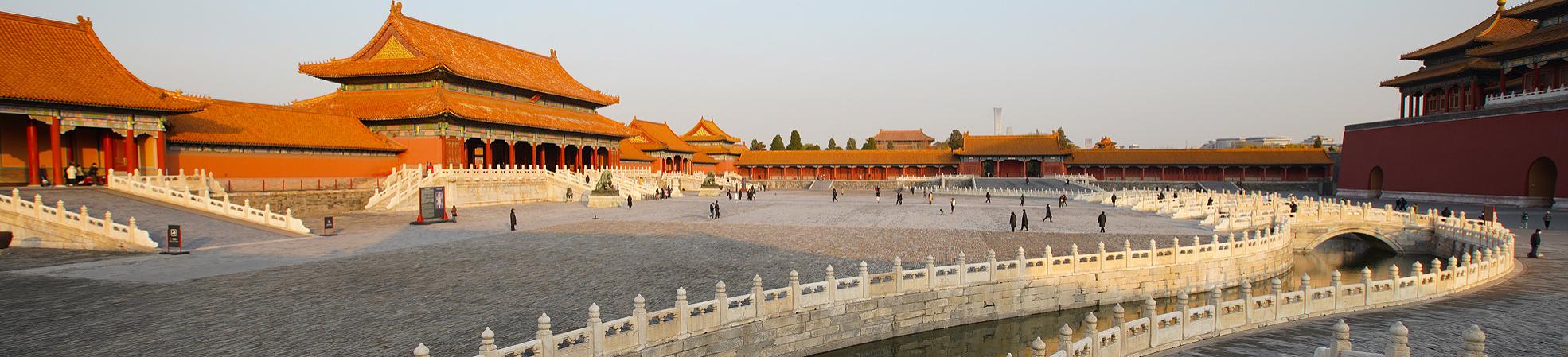
Beihai Park in Beijing
Beihai Park is a masterpiece of imperial garden design. Originally designed in the Ming Dynasty (1368-1644) on the ruins of a Yuan Dynasty Imperial Garden in Beijing, China. The current park has a history of over 800 years. It was built in what is known as a "one pool and three hills" design. The design comes from a Taoist legend that says that somewhere in the East Sea there are three islands that were home to the immortals. The emperors wanted to be immortal so they built gardens in this fashion in the hopes of becoming immortals.
Beihai Park is the most intact ancient royal garden in China, which seamlessly integrates architecture and nature. It is filled with temples, pavilions, and carvings, and each is made of the highest quality. This was the private garden of the emperor and being such, money was no object. Beihai Park, once the sole property of the emperor now thousands of tourists visit every day. There are dozens of amazing sites in this beautiful park, making it an irresistible place for visitors to take their Beijing tours.
Yong An Bridge:
Yong An Bridge was built in the thirteenth century. It is a long, multiple-arch stone bridge that connects Qiong Island with the bank on the other side of Beihai Lake. At the north and south ends of Yong An Bridge, there are two colorful memorial stone archways whose names are Ji Cui and Dui Yun. There is one pair of stone lions in front of each stone archway. Against the green water, the blue sky, and the White Dagoba, Yong An Bridge presents a splendid sight.
Qiong Hua Island:
Qiong Island is the short name of Qiong Hua Island. There is the White Dagoba on top of the mountain on the island that can be seen for miles. The hill is often called White Dagoba Hill. The hill is 32 meters tall and has a perimeter of 913 meters. Qiong Hua means gorgeous gem, so the name of the island means that the island is a gorgeous gem located in the center of Beijing. Standing on the top of the hill, tourists will have a wonderful bird's eye view of Beijing.
The White Dagoba in Beihai Park:
The White Dagoba in Beihai Park is a lama tower. It is 35.9 meters tall, round on the top and square on the bottom. There is a roof crown on the top of the Dagoba covered with a sun, moon, and flame motif. It is used to symbolize that the power of The Buddha is radiant like the sun and the moon. This Dagoba stands tall and upright on the Peak of Qiong Hua Island and can be seen for miles.
Nine-Dragon Screen:
The Nine-Dragon Screen is symbolic of Beijing. It is made of colored glazed tiles and is the most splendid of the three imperial nine dragon screens. Built-in 1756, the screen is 25.78 meters long, 6.65 meters tall and 1.42 meters thick.
What makes this screen unique among the three is that there are designs on both sides of the screen. Each side of the Nine-Dragon Screen has nine large dragons and dozens of small ones on the roof and border details. They are playing pearls in the clouds and waves. The reason the screen has nine main dragons is that nine was considered to be the number of the emperor. In Taoist philosophy, men are odd numbers while women are even numbers. Since the highest odd single-digit number is nine, it was the emperors. Beihai Park's Nine Dragon Screen is one of the four well-preserved Nine Dragon Screens in China, which are precious examples of the artistry of ancient Chinese. Another Nine Dragon Screen in Beijing is sited in the Forbidden City. Almost all Beijing tour packages will comprise a visit to at least one of them.
Beihai Park has numerous places of interest such as the Tian Wang Palace Hall, Yue Xin, Palace Hall, Beihai Lake, and the Alter to the Goddess of Silkworms. One visit to Beihai Park is usually never enough with so many wonderful places to explore that it often leaves visitors wanting more and pledging to someday return.
Contact us for a tailor-made China tour incl. Beihai Park!
Quick Question



What Our Clients Say

SUBSCRIBE TO WIN A FREE TOUR
Subscribe to our newsletter for a chance to win a free 7-day Morocco tour! And more insider travel news, exclusive offers, and inspiration will be sent straight to your inbox.
