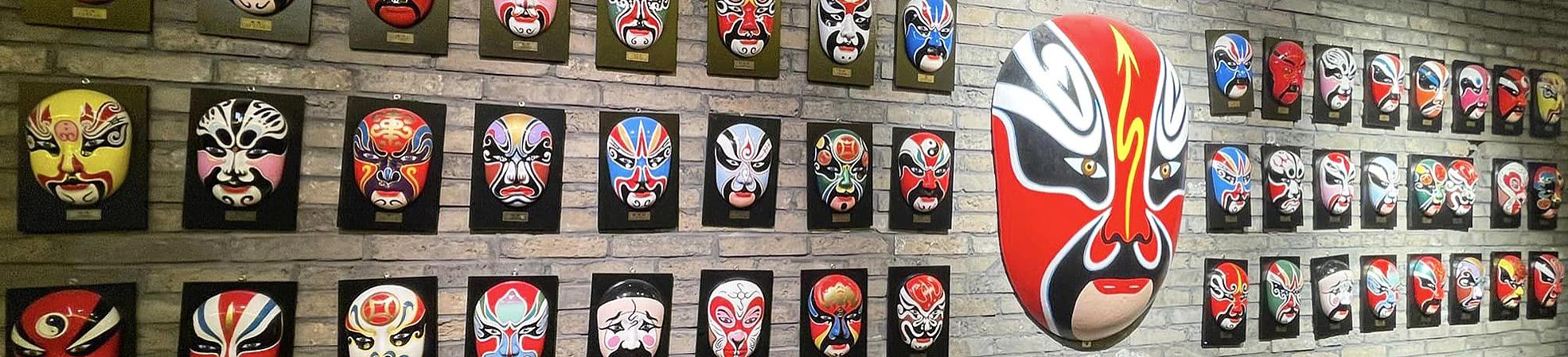
Peking (Beijing) Opera - the National Opera of China
Known as the national opera of China, Peking Opera is the most influential and representative of all the operas in China. It is the highlight of any Beijing tour. Peking (Beijing) Opera is a blend of music, dance, art, acrobatics, and martial arts. After reading this article, you will know more facts about Peking Opera and the best places to watch one.
Basic Facts of Peking Opera
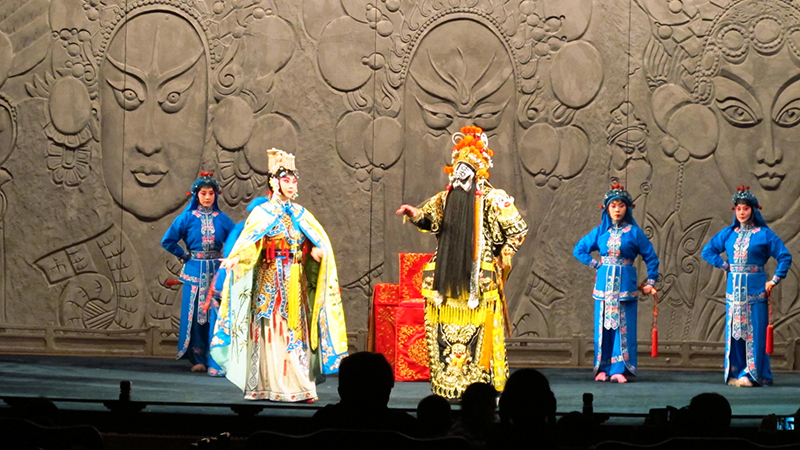 Peking Opera
Originating in the late 18th century, Peking Opera features a rich repertoire of stories from history, folklore, and mythology, characterized by elaborate costumes and distinctive facial makeup. In this part, we will briefly introduce Peking Opera.
Four Main Kinds of Roles
The characters of Peking Opera are generally divided into four types of roles: Sheng, Dan, Jing, and Chou. Every type of role has its own characteristics, so the audience can distinguish them easily.
Sheng
Sheng is the general name for male roles in Peking Opera. There are subtypes of Sheng role. Here, we mainly introduce three of them. However, most of the Sheng characters are noble and positive.
Laosheng: Laosheng refers to elder or middle-aged male characters. Basically, they are high-ranking officials or scholars. The actors of Laosheng have to wear a long and thick beard, which is usually black or white.
Xiaosheng: Xiaosheng refers to young males with a good-looking appearance and no beard. Generally, they are young scholars or warriors.
Wusheng: Wusheng refers to males who are really good at martial arts. They will perform swords or spears dancing on the stage.
Dan
Dan is the general name for female roles in Peking Opera. In ancient times, all Dan roles were played by men. Nowadays, they are played by both male and female actors. There are some of the most common subtypes of Dan roles.
Zhengdan: Zhengdan refers to middle-aged female characters. They are usually mothers or wives and have high social status. Zhengdan is also called Qingyi because they often wear light blue dresses.
Huadan: Huadan refers to lively young ladies in Peking Opera. Compared with Zhengdan, Huadan focuses more on speaking and movements than singing.
Daomadan: Daomadan refers to young female warriors. Usually, they will perform horseback riding with a spear in their hands. Daomadan characters will sing and dance with whatever weapons they have. They will wear warrior costumes with flags on their backs.
Wudan: Wudan roles are specialists in fighting, especially with all kinds of weapons. Unlike Daomadan, they seldom speak or sing during the whole Peking Opera performance. Laodan: Laodan refers to older women. Usually, they will wear simpler dresses and speak or sing.
Caidan: Caidan refers to female roles that bring comedy effects to Peking Operas. They won't act like normal female roles. They will make clownish gestures and speak in ordinary voices. Nowadays, most of the Caidan roles are played by men.
Jing
Jing is the general name for rough or mighty male roles in Peking Opera. They require heavy face painting. Due to the personalities of Jing roles, you will find that they all have a strong and heavy voice and exaggerated gestures. The main color of the painting on their faces implies what kind of people they are. There are three main kinds of Jing roles: Jiazi, Tongchui, and Wujing.
Jiazi: Jiazi refers to rude and reckless male roles at high social status, like generals and commanders. They will focus on movements and speaking.
Tongchui: Tongchui refers to strong and upright male roles at high social status, like judgers and officials. They will focus on singing.
Wujing: Wujing refers to male roles of low social status that have distinctive characters and know martial arts. They will focus on movements and fighting, seldom speak or sing.
Chou
Chou is the general name for clownish male roles in Peking Opera. Normally, Chou roles won't sing. They focus on movements and basically speak in normal voices. They can play smart and humorous positive roles. Also, they can play evil, immoral, and negative roles.
Facial Makeups
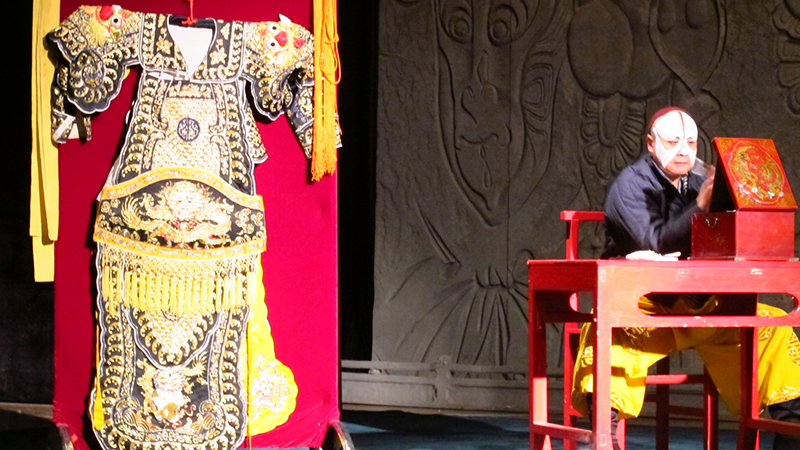 The actor is making up for a Peking Opera
The facial makeup of the Peking (Beijing) Opera highlights and emphasizes the principal features of the characters. The main color of facial makeup of a certain role determines the personalities. The following table covers the main colors that are most commonly used for facial painting.
| Main Color | Personalities |
| Red | Positive, brave, and honest |
| White | Negative, cunning, and insidious |
| Black | Positive, upright, stern, just |
| Blue | Positive, strategic, wise, and skillful |
| Green | Positive but grumpy, reckless, and rash |
| Yellow | Positive but cruel, ferocious, and rude |
However, there are few exceptions. For example, many Chou roles will draw a big white circle in the middle of their faces. That doesn't mean they're playing negative roles. When the main characters are animals, such as the Monkey King in Havoc in Heaven, they need more complicated facial painting. In this case, it's hard to tell the personality at first sight.
Besides watching Peking Operas, our Beijing tours include facial makeup experience. You can get a facial painting with your favourite color. If you're interested in this activity, write to us and we'll arrange it for your China tour.
History
Although it is called Peking Opera, its origins are not in Beijing but in Anhui and Hubei provinces. It is believed that the Peking (Beijing) Opera gradually came into being after 1790, when Anhui Province's four most famous opera troupes paid a visit to Beijing. Based on traditional Anhui Opera, Peking (Beijing) Opera has also adopted repertoire, music, and performing techniques from Kun Opera and Qingqiang Opera, as well as traditional folk tunes. It took the best from each style and eventually formed its own highly stylized music and performing techniques.
Peking Opera underwent fast development during the reign of Emperor Qianlong and the notorious Empress Dowager Cixi of the Qing Dynasty. Having an imperial patron made Peking Opera extremely popular. Therefore, it was more accessible to the common people. Empress Dowager Cixi was an avid fan. The huge three-story theater in the Summer Palace is proof of her love of Peking Opera.
Where to Watch Peking Opera in China
Peking (Beijing) Opera is a must-see of a Beijing tour. Thus, we've compiled the best Peking Opera theatres in Beijing for you.
1. Mei Lanfang Theatre
Mei Lanfang Theatre provides classical and modern Peking Operas. Basically, modern Peking Operas are adapted from novels written in the middle and late 20th century. All the performances start at 7:00 PM or later.
2. Beijing People's Theatre
The Beijing People's Theatre, originally built in 1953, reopened on October 16, 2023. It offers Peking Opera performances, with sessions available both during the day and in the evening.
3. Chang'an Grand Theatre
Chang'an Grand Theatre has over 70 years of history and provides classical Peking Opera performances. Compared with other top theatres, the ticket price here is cheaper, starting at 50 yuan per person.
4. Zhengyici Peking Opera Theatre
Zhengyici Peking Opera Theatre was not only a theatre but also a historical landmark in Beijing. It was built in 1688. Now it's restored and well-maintained so that people can enjoy the Peking Opera in this theatre.
5. National Centre for the Performing Arts (NCPA)
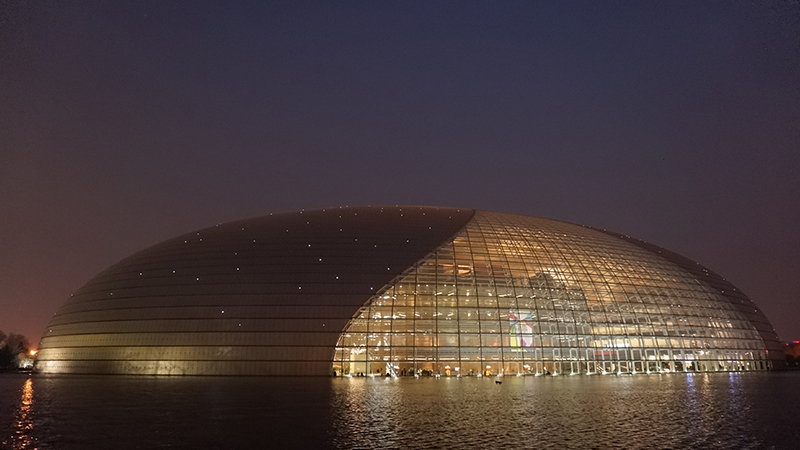 The National Centre for the Performing Arts in Beijing
The National Centre for the Performing Arts is located in the center of Beijing. And it's the best theatre in China, with high-end equipment. However, Peking Operas are not the only performances here. You can also enjoy other kinds of art, like concerts and dance festivals.
If you want to enjoy a Peking Opera during your China tour, contact us and we will help book a ticket for you.
Most Famous Peking Operas in China
Here are the five most famous Peking Operas in China. After reading these brief introductions, you will have a clearer idea about what to watch in Chinese opera theatres.
1. Farewell to Concubine
The kingdoms of Chu and Han were at war. General Xiang Yu of the Chu Kingdom was surrounded by the Han army at Jiuli Mountain. In order to cheer up Xiang Yu, his concubine, Yu Ji, sang songs, performed a sword dance, and killed herself with the sword. This is the magnum opus of the Mei School of Peking Opera.
2. Havoc in Heaven
This is an ancient Chinese fairy tale. The Empire of Heaven was having a huge peach banquet but did not invite the Monkey King. This angered the Monkey King so much that he went up to heaven before the banquet and ate all the peaches and the Pills of Immortality intended for the banquet. He then proceeded to destroy many of Heaven's palaces. Due to its large amount of martial arts, this is one of China's most popular Operas.
3. The Crossroad
Jiaozan, a senior official of the Song Dynasty, was exiled to Shamen Island because he killed a treacherous court official. The commander-in-chief, Yang Yanzhao, sent Ren Tanghui to protect Jiaozan secretly. During the night, Ren stayed at the same crossroad as Jiao. In that inn, a fierce fight took place between Ren Tanghui and the innkeeper, Liu Lihua, who thought Ren Tanghui wanted to murder Jiaozan. The fight waged for hours until Liu Lihua's wife came in with a lit candle. The two men recognized each other, and this cleared up their misunderstanding.
4. Picking Up a Jade Bracelet
A young girl named Sun Yujiao enjoyed doing embroidery work in front of her family's gate. One day, a young intellectual named Fu Ming passed by and instantly fell in love with her. Fu Ming dropped a jade bracelet on the ground on purpose to express his love. Sun Yujiao picked it up, which signified her acceptance of his love. Before Fu Ming dropped off the bracelet, she did not like him, but when he gave this display of his love for her, she changed her mind. This is a very traditional style of Chinese love story.
5. The Drunken Concubine
One day, Emperor Xuanzong of the Tang Dynasty invited his favorite concubine, Yang, to admire flowers in a pavilion. Yang waited for the emperor but he never showed up. Instead, he went to another of his concubine's residences. Angered at being jilted, Yang felt depressed and got drunk. She sang to express her sadness and went back to her own palace, filled with resentment.
Plan a Tour With Us
Apart from the Peking Opera, there are other amazing things and landscapes in China waiting for you. Start to plan your China tour with us by writing to trip@odynovotours.com. All the details can be customized to meet your needs!
Quick Question
Recommended Tours
-

China Historical Discovery with Kung Fu
14 DaysBeijing, Xi'an, Luoyang, Dengfeng, Zhengzhou, Nanjing, Shanghai -
Classic China With Guizhou Minority
17 DaysHong Kong, Guilin, Zhaoxing, Anshun, Guiyang, Xi'an, Pingyao, Beijing -
-
Yunnan and Chengdu Tour From Hong Kong
13 DaysHong Kong, Kunming, Dali, Lijiang, Shangri-La, Chengdu


What Our Clients Say
"Great Customized Service", "Trip of A Lifetime", "Exceed All Expectations"
SUBSCRIBE TO WIN A FREE TOUR
Subscribe to our newsletter for a chance to win a free 7-day India tour! And more insider travel news, exclusive offers, and inspiration will be sent straight to your inbox.