Buyi Ethnic Minority Group in Guizhou
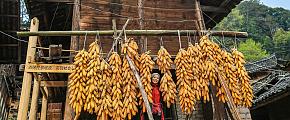
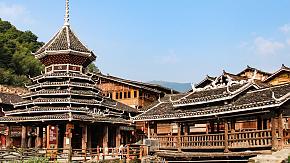
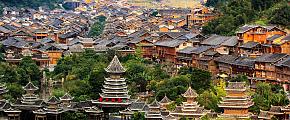
The Buyi or Bouyei ethnic minority group is the second largest minority group in Guizhou Province. Buyi people are very frank and friendly. They hold the elderly in very high respect. Buyi villages are always located near rivers, and the villages are fairly small. Normally a village will only house a couple of dozen families, but some villages have been known to hold several hundred households. Their houses are made of stone. The Buyi people are primarily farmers and are proficient at growing foods as well as animal husbandry.
 Buyi People
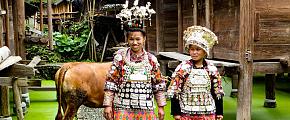
The clothing of the Buyi minority group is unique. Men traditionally wear long-sleeved short shirts with long pants. Young men like to wear a headdress which consists of scarves of black or lattice cloth. In Guizhou alone, women's clothing comes in four different styles: northwest, southwest, central, and eastern styles. In northwest Guizhou, women wear short black jackets. The jacket is tied with a band of cloth. The cuffs and front have batik on them. The jacket is worn with a pleated skirt, an apron, and a turban. They also wear silver accessories. The central style of clothing consists of long green pants, silver ornaments, and an apron. In the southwest, the women wear long pants with a long-sleeved blue jacket, an embroidered coat, and a long pleated skirt. The sleeves and shoulders of the coat are normally decorated with batik or embroidery. The eastern style includes a dress and pants trimmed in lace and a turban. No matter which style of clothing is worn, each is handmade with care by the girl who wears it. Girls are taught at a young age to do embroidery and to make the Buyi minority batik.
The Buyi batik has been famous for thousands of years, and the Buyi people are taught to create it at a young age. Batik is created by painting patterns on white cloth with wax. The cloth is then dipped into a bath of indigo dye. When the cloth has dried, the wax is scraped off and then the cloth is boiled to remove all of the wax left in the cloth. The areas where the wax was are white, while the surrounding areas are indigo. Common designs used in batik production are flowers, waves, and chains. In recent years, more modern designs have been created. Buyi people are also known for their embroidery. Originally used only for their own clothing, in recent years, the Buyi people have started selling their embroidered cloth to the public.
The Buyi festivals revolve around forming new and renewing old friendships. The festivals are usually held in the forests or on the hills surrounding the village. The festivals are huge community parties that include singing, dancing, games, and courtship activities. The Chabai Singing Festival is held from the 21st to the 23rd day of the 6th lunar month on the Chinese calendar. Tens of thousands of visitors from neighbouring villages, provinces and even countries come to witness and participate in the festival. The main activity during the festival is singing contests. During the day, the singing contests are held in the village's open areas, but in the evening it is performed in the courtyards and houses of the locals. The Ox-King Festival is held on the first day of plowing. The most interesting part of the Ox-King Festival is the multi-coloured rice that is eaten. Each family takes rice and dyes it into five different, very bright colours. The rice is then steamed. The rice is offered to the ancestors, and then half of the rice is fed to their oxen, who are then allowed to rest for the remainder of the day. The festival, known as the March 3rd Festival, celebrates the local mountain and village gods.
The Buyi ethnic minority group, like all of the minority groups in Guizhou, is very unique. Its ancient customs and traditions have been kept alive and even in today's modern age, the Buyi people still continue to wear their traditional clothing. Their colourful customs have intrigued visitors very many years, and Guizhou's minority groups are starting to draw more visitors each year.
Contact us for a tailor-made China tour.